CS/Lecture Note
[OSS] Machine Learning with scikit-learn
Uykm
2023. 11. 12. 22:34
▼ Machine Learning
Machine Learning
- 머신 러닝은 Induction(귀납법)을 기반, 데이터를 중심으로 하는 방법이다. (↔ Deduction(연역법))
vs. Deep (neural network) learning
➜ 데이터가 적게 발생하는 케이스는 '머신 러닝' 을 여전히 사용한다.

- ML procedure (~ trial and error)
- Data acquistion
- Data preprocessing (e.g. labeling)
- Feature selection and extraction
- Model and cost funcion selection (or design)
- Hyperparameter selection (e.g. optimizer, learning rate)
- Model training
- Model testing
- ML approaches
- Supervised learning (지도 학습)
➜ 입력(inputs)과 올바른 출력값(desired targert; 정답)을 주어준다.
(-/+) target을 찾기가 어렵지만, 좀더 속도가 빠르다. - Unsupervised learing (비지도 학습)
➜ 입력(inputs)만 주어준다.
(+/-) target을 제공할 필요가 없지만, 문제가 잘 안풀릴 가능성이 더 높다. - Reinforcement learning (강화 학습)
➜ 피드백(reward/penalty)을 통해 학습하는 방식이다.
- Supervised learning (지도 학습)
- targe(목적)에 따른 ML problem의 유형
- Classification
➜ 주어진 데이터의 카테고리를 분류하는 작업. (discrete) - Regression
➜ 주어진 데이터에 적합한 parameters를 찾는 작업. (continuous)
ex) Line fitting - Clustering
➜ 유사한 데이터끼리 집합으로 묶는 작업. - Dimensionality reduction
➜ 주어진 데이터의 차원을 낮추는 작업. - Model selection
➜ 주어진 데이터에 적합한 parameters를 찾는데, 타입도 찾아주는 작업. - Reinforcement learning
➜ 피드백을 통해 누적 보상액(reward)가 최대가 될 수 있는 정책(policy)를 찾는 작업.
- Classification

▼ scikit-learn
scikit-learn
- 파이썬에서 사용하는 '머신 러닝' 라이브러리 중 하나이다.
Iris flower dataset
- Loading the Iris flower dataset
from sklearn import datasets

iris = datasets.load_iris()

print(iris.target_names) 	# ['setosa' 'versicolor' 'virginica']
print(iris.feature_names) 	# ['sepal length (cm)', ...]
print(iris.data.shape) 		# (150, 4)
print(iris.target.shape) 	# (150,)
- How to use (3 steps)
- Instantiation
- Training (fit : 학습 function)
- Testing (predict)
import numpy as np
import matplotlib.pyplot as plt
from sklearn import (datasets, svm)
from matplotlib.lines import Line2D # For the custom legend

# Load a dataset
iris = datasets.load_iris()

# Train a model
model = svm.SVC() 					# Accuracy: 0.973 (146/150)
model.fit(iris.data, iris.target) 	# Try 'iris.data[:,0:2]' (Accuracy: 0.820)

# Test the model
predict = model.predict(iris.data) 	# Try 'iris.data[:,0:2]' (Accuracy: 0.820)
n_correct = sum(predict == iris.target)
accuracy = n_correct / len(iris.data)

# Visualize testing results
cmap = np.array([(1, 0, 0), (0, 1, 0), (0, 0, 1)])
clabel = [Line2D([0], [0], marker='o', lw=0, label=iris.target_names[i], color=cmap[i]) for i in range(len(cmap))]
for (x, y) in [(0, 1), (2, 3)]:
	plt.figure ()
	plt.title(f'svm.SVC ({n_correct}/{len(iris.data)}={accuracy:.3f})')
	plt.scatter(iris.data[:,x], iris.data[:,y], c=cmap[iris.target], edgecolors=cmap[predict])
	plt.xlabel(iris.feature_names[x])
	plt.ylabel(iris.feature_names[y])
	plt.legend(handles=clabel, framealpha=0.5)
plt.show()
▼ Classification
Binary classification
- 스팸 메일을 분류할 때, 해당 e-mail이 스팸인지 아닌지를 결정하는 경우를 예로 들 수 있다.
- Accurarcy: # of correct / # of data
➜ 아래처럼 데이터의 개수가 다르면 뭐를 return 하느냐에 따라 정확도가 달라진다.
➜ 비율을 맞춰주거나 더 적은 데이터에 가중치를 주어서 해결 가능 !
def is_spam_always_true(text):
	return True # Accuracy: 0.1 (10/100)

def is_spam_always_false(text):
	return False # Accuracy: 0.9 (90/100)
- Confusion matrix
➜ 해당 클래스가 맞았는지 틀렸는지를 2차원으로 생각하는 방식.
Actual class(스팸인지 아닌지) / Predicted class(예측이 맞았는지 틀렸지)
- Accuracy : 스팸(P) vs. 일반 메일(N)
- Balanced accuracy : 스팸 중에서 얼마나 맞았는지 vs. 일반 메일 중에서 얼마나 맞았는지
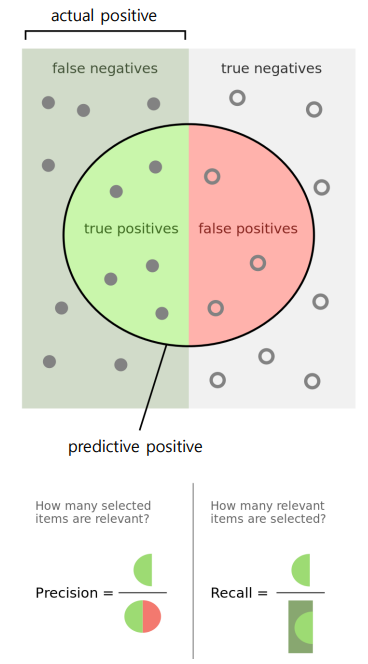
- Recall : Positive라고 한 것 중에 얼마만큼이 맞았는지
- Precision : 맞았다고 한 것 중에 Positive가 얼마만큼 있는지
- F1-measure : Recall + Pecision
- False positive rate : Negative라고 한 것 중에 얼마만큼 맞았는지 (높을수록 Bad)

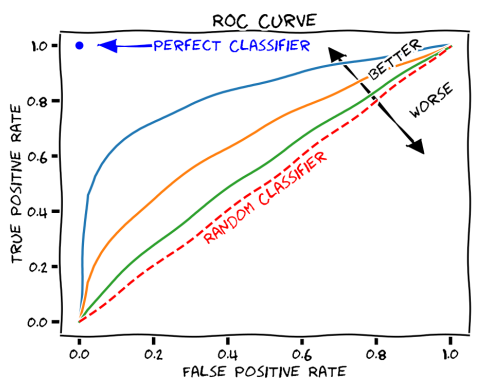
- ROC curve (Receiver Operating Characteristic curve)
from sklearn import metrics

y_true = [False] * 90 + [True] * 10 # True labels
y_pred = [False] * 99 + [True] * 1 # Predicted labels

print(metrics.accuracy_score(y_true, y_pred)) 					# 0.91
print(metrics.balanced_accuracy_score(y_true, y_pred)) 			# 0.55
print(metrics.precision_score(y_true, y_pred)) 					# 1.0 = 1 / 1
print(metrics.recall_score(y_true, y_pred)) 					# 0.1 = 1 / 10
print(metrics.f1_score(y_true, y_pred)) 						# 0.18 = 2 * (1.0*0.1) / (1.0+0.1)
print(metrics.precision_recall_fscore_support(y_true, y_pred)) 	# ...
print(metrics.classification_report(y_true, y_pred))

conf_matx = metrics.confusion_matrix(y_true, y_pred) 			# np.array([[90, 0], [9, 1]], dtype=int64)
																# x축과 y축이 뒤집어져서 나타난다.
conf_disp = metrics.ConfusionMatrixDisplay(conf_matx, display_labels=['false', 'true'])
conf_disp.plot()
- Multiclass classification
➜ 4를 9로, 3을 5로, 6을 5로 판단하는 경우가 많은 것을 알 수 있다. (classification을 잘하지 못한 부분)
➜ 잘된 부분과 못한 부분 모두 확인 가능

▼ Regression
▼ Clustering
▼ Machine Learning FAQ
Machine Learning FAQ
- 학습을 통해 좋은 결과를 얻기 위해선 많은 'trials(moer data/computing power)' 도 필요하지만, 직관(intuition)과 experience(경험)도 중요하다.
- Good hyperparameter values ?
➜ Grid 탐색을 통해서 모든 경우를 시도해보거나 직관이나 경험을 활용하자. - Good model ? Enought training ?
➜ 주어진 데이터에 비해서 모델이 너무 가볍거나 복잡한 경우 아래와 같은 문제 발생.
➜ Underfitting vs. Overfitting
➜ 적당한 모델을 어떻게 선택 ?
➜ Training data(무에서 유로 갈때 필요한 데이터), validation data(검증하기 위한 데이터), 그리고 test data(성능 측정하기 위해 남겨놓은 데이터)를 따로 분리해서 결과를 보고 선택하자 ! - Enough data ?
➜ 데이터가 많은 것은 항상 좋지만, 데이터의 차원(dimenstion)과 모델의 파라미터(parameter)의 수를 고려해야 한다.
- Good hyperparameter values ?

- Underfitting(training을 더 오래할 필요!) vs. Overfitting(더 가벼운 모델을 쓸 필요!)

- Cross-validation (CV)
➜ 훈련된 모델이 얼마나 일반화가 잘 되었는지 !
➜ 즉, 학술적 연구를 할 때 같은 데이터가 있더라도 어떻게 훈련(training)하고 검증(validation)하냐에 따라 결과가 달라지기 때문에, 재현 가능한 결과를 도출하기 위해 사용하는 방법이다 !
- Exhaustive cross-validation
➜ 모든 경우를 다 따져보는 방법.
C(n,p) ➜ p가 1인 경우에만 가끔 사용한다. - Non-exhaustive crowss-validation
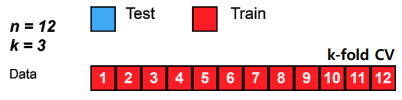
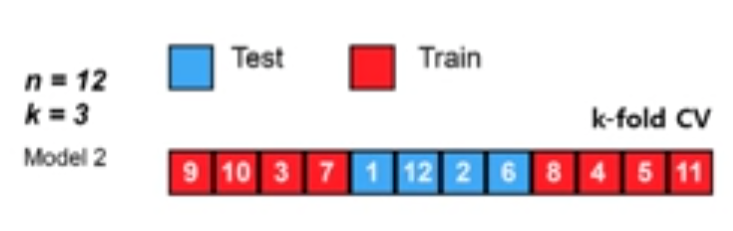
➜ 전체 데이터를 k개 정도로 줄여서 검증하는 방법. (k-fold cross-validation)
- Exhaustive cross-validation